Friday, October 19, 2012

Journey to JinDao Gorge

Where might I go that would combine some of my favorite memories of home (Rock Bridge Park and the spectacular limestone caves and crevices there), the New Zealand Hollyford trek (with waterfalls sprouting out everywhere through lush mountainside vegetation), and even the Khumbu valley in the shadow of Mount Everest (where mountainside dwellings have some similar architecture and sherpas carry heavily laden baskets on their backs)? Maybe the JinDao Gorge, also cutting deeply and spectacularly through karst landforms, only a two hour bus ride away from Beibei. My photographs simply do not do justice to the scale or to the colors. Last Sunday, my Peace Corps Volunteer friend Martha joined me on the trek, where we met up with several Chinese students from a university in Chongqing who decided to be our guides.


Friday, October 12, 2012

Alternative Dream - Big Time


I don’t always agree with NYT columnist Thomas Friedman, but something he said about dreams a few days ago resonated with me. He speculated that the “American Dream” would not make a smooth jump across the Pacific to China—the dream of a big house, two cars, and more. Friedman was sort of wagging his finger, warning China that its emerging materialism and rising consumption of valuable resources, including water, could be disastrous, not only for China, but also for the rest of the world. 

Now, I am a baby boomer who would be exceedingly hypocritical if I didn't admit that I have benefited from material well-being and many other aspects of "the American dream," and I have no ground to point fingers. Still, that doesn't stop me from warming to Friedman's argument.

Friedman cites Peggy Liu, who says that China recognizes the problems stemming from an unbridled pursuit of "the American dream" and has an alternative, sustainable dream, one that, as Friedman paraphrases Liu, "merges traditional Chinese values, like balance, respect and flow, with its modern urban reality."

If so, scale may be both the problem and solution. Obviously, China is not the only country with mounting consumption—of water, gas, other resources--but it may be the only country entertaining this consumption on such a grand scale. It’s hard for me to get a grip on the magnitude of just about everything in this huge and ancient country that is home to more than one in five people on the planet. So, again, the scale that characterizes China's problems may be the scale that characterizes its dreams and potential solutions.  

I find it exciting to contemplate that China's alternative dream might include some elements of a market economy without sacrificing all protections of the common good and without sacrificing such healthy habits as walking to work, buying vegetables from vendors on the street, eating slowly, putting on another sweater rather than turning up the heat, and carrying your own bags.

I find it exciting to contemplate that this sustainable alternative dream, one that balances the public good with a market economy, could come to fruition on a gigantic scale.

It's an alternative dream that not only has political and environmental consequences, but also has, to my way of thinking, sensory and aesthetic consequences. I, for one, simply enjoy the richness of what I see, hear, and smell when I live as lightly as I can upon the earth, wherever I am--here, home, wherever. 

Without as many cars per capita, we live more closely together, which, for me, means that I can hear the splat of diced vegetables hitting the oil in woks in several adjacent buildings. We can smell each other's onions and lajiao. The windows and balcony doors are open--we see each other's hand-washed laundry hanging well above our potted plants to dry. I hear the man on the fourth floor across the way vigorously chopping his ingredients. Someone is learning to play the trombone and isn't terribly good yet, but there are several exceptionally good pianists nearby. A woman with a basket on her back strolls the walkways, chinking together two pieces of metal to announce that she is there, should anyone need to recycle anything. Another peddler outfitted with a basket on his back calls out over and over, as if he is trying to find someone, but he is simply advertising his goods. Music drifts up from a small park below where the ladies are doing Tai Chi--and there are trees and benches there and everywhere because people need these small parks when they turn out of their apartments to play mahjong or dance or talk or wait to pick up little schoolchildren. The parks and public squares are used, all the time by people of all ages. Without as many cars per capita, people must share the common spaces and do--there is community.

Without as many cars per capita, we walk more places, which, for me, means that I can see the moss covering the high stone wall along the path, I can see the azalea blooming in a neighbor's porcelain pot, I can see the gray trousers being pushed through the tailor's sewing machine and I can see the red high heeled shoe that the curbside cobbler is mending. I can see floating leaves interrupting the reflection of the willows around the little pond by the physics building. 

Sleeping is good, usually, because of all this. I've typically walked many, many miles by the end of the day, and nights are now quite cool. Most people's windows are still open, although I have closed my little balcony doors now that it is dropping down to almost 50 degrees F at night. And, because so many of us live so close together, there is only so much space. With only so much space, I don't have more material goods than I can use. I don't buy much, and I don't throw away much.

If there were even more cars, there would need to be more ugly parking spaces, and the buildings would be spread out. Instead of taking five minutes to get to scores of closely-packed shops and  noodle places, it'd take much longer. The umbrella covered vegetable stands on every corner would have to go. Nobody would stop me on the street to speak to me.

Again, this alternative dream of living lightly on the earth while enjoying some of the benefits of a market economy is not a new dream, not at all--and many have written more eloquently than I have here  about it. The thing that has come home to me, though, while reflecting on Friedman's piece is that China not only has a history rich with sustainable practices well worth keeping, but also has the potential to shape our planet's dreams. If China pursues this alternative dream, it will be big time.

Thursday, October 4, 2012

Jasmine Bracelets and Moon Cakes


Mid-Autumn Festival celebrates the harvest; the ancient legend of Houyi, Feng Meng, and Chang'e (the Moon Goddess); and, most importantly, the ongoing significance of family and reuniting with loved ones. Chinese trains and buses were teeming with people headed home to share the holiday with family this past week. Of course, nobody will take the place of my sons and sibs, but my extended Chinese family has been unbelievably hospitable and generous.
Adam Jones photograph.
Moon cakes, dense and delicious, are shared with family and friends. Special thanks to my waiban, to Li Ling and her family, to Li Ying and Peng Laoshi, to Mrs. Liu and Mr. Mou, and to many students for lavish gifts and good wishes. Thanks to Zuo Jia who first bestowed her jasmine "bracelet" upon me  (she threaded around my wrist sweet-smelling flowers from her roof-top garden) after striking up a conversation at a lecture and then invited me to a holiday luncheon. www.mrbigben.com image.


Friday, September 28, 2012

Big feet

This entry will be very short, but the topic is very big: my feet. So big are my feet that I would have to go barefoot if I hadn't brought several pairs of shoes and boots with me to China. The entry is very short because, well, I had another problem with translation, leaving me with little spare time tonight.

(The translation problem: I clearly understood the message from university officials saying that there would  be a make up day tomorrow, Saturday, for one of the days that would otherwise be missed because of our upcoming holidays. I didn’t realize, however, that the make up class applied to the Friday morning class I had just I taught, a three-hour seminar. But I now realize that I'm expected to teach another three-hour seminar to the very same students tomorrow. Ouch! I will be up late tonight! After class tomorrow, students will disperse to far flung corners of China for several days of holidays: National Day celebrating the 63rd anniversary of the founding of the People’s Republic of China, immediately followed by Mid-Autumn Festival, one of the most important Chinese holidays. This is the holiday for eating moon cakes.)

But my big feet: Although nobody makes shoes my size, my favorite cobbler is happy to fix my well-worn Ecco shoes for the equivalent of 50 cents. These are shoes that should have been retired years ago and are totally unlike any of the spike heels that most college women seem to wear anywhere and everywhere—to class, to the grocery store, to JinYun Mountain.

 You can’t tell in the picture below that I’m standing in the doorway of one of the many shops lining a big city street or that the shops make an elbow, leaving just enough room for a tree from which the cobbler hangs his umbrella like a porch roof, a little stool about six inches high, a little post with a metal platform on which to place an upside down shoe, a little iron contraption, and assorted pouches with needles, thread, hammer, nails, pliers, superglue and the like. The cobbler is never out of work for long, and as you can see in this photo, half a dozen women have recently dropped off plastic bags full of things for him to repair. You’ll occasionally see some Deedle Deedle Dumpling perched on the step, one shoe on, one shoe off, conversing with the cobbler while the cobbler mends the shoes.


Friday, September 21, 2012

Noise

I might not live through another night of this noise, and now I'm given to understand that there will be two more long days and nights of it.

True, this noise isn't the very loudest noise I've heard since being in China. The loudest noise happened to erupt at Sichuan Shifan Daxue during language class one day last summer, when suddenly my Chinese teacher stopped talking about measure words for "piao" and "ke" and the four of us seated in a U-shape around him were frozen by a piercing scream. The single scream escalated and more voices joined in. We just couldn't imagine who or what was being dismembered next door. Nothing on a maternity award or a psych ward or any such place could match this screaming as far as I knew, and it kept escalating. We, of course, shot into the hall to investigate, only to bump into a dozen other anxious Peace Corps volunteers and the three screamers, who just happened to be the other three teachers.

These three teachers are exceedingly intelligent women, kind, too, but they apparently don't like little things that move and there apparently was just such a little thing moving under one of their desks. In the hall, they held hands, as is common for Chinese women of any age to do, and started backing toward the stairs.

Ever curious, several of us got down on our hands and knees, eager to get a glimpse of the wayward mouse or beetle or whatever it was. We spotted the suspect under a table leg, and I finally cupped it in my hand and stepped outside, only to trigger another round of screams from the women who had not yet reached the stairs. The cute but anticlimactic answer to the day's mystery was just a tiny green gecko.

But no gecko could account for the explosion I heard yesterday morning. I was talking to Christopher, who heard it from his couch in St. Louis, and thought it sounded like a truck dumping a load of gravel on my balcony. I thought it sounded like an explosion of guns. Unlikely though it would be, could it be something to do with the thousands of freshmen donned in brown shirts, red ties and military caps, flanked in formations across the soccer fields for a month of compulsory military training? No, they wouldn't have guns, and this noise was close, on this side of the big city avenue. Fireworks? But on a Saturday morning? National Day (think Fourth of July) isn't until October! But then, Missouri has firework stands going up two weeks before the Fourth--maybe the firework sales were underway?

Every ten or fifteen minutes, I'd hear another round of earsplitting racket. So, I trotted up the hill to find my landlady Mrs. Niu to make enquiries but found only a note on her door with a telephone number. Not long after, though, when I was headed to market, she stepped out from behind a sewing machine at the tailor's to shout out a greeting. I stopped, glad to see her. My Chinese served me well enough to ask her what the loud racket was but didn't serve me well enough to understand her impassioned answer. That it had nothing to do with the university students I did understand, but nothing else.

For the rest of the day I tried to ignore the periodic bursts of sound, but by nightfall irritated cats and babies were joining the ruckus and, spliced in between what could only be fireworks, were other unhallowed noises and unmusical instruments, some screeching and eerie, all loud and persistent.

Way below the road to the foreign teachers' apartments is the park where ladies do Tai Chi most nights, and there I saw a huge white tent with tables under the bamboo. Again, maybe they were selling fireworks early before National Day, but why blast off the goods all day and night? Thousands of kuai must have gone up in smoke already. Why all night? Why so much?

At three on Sunday afternoon my beloved tutor showed up, one of the ex-screamers from summer training (who happens to be a grad student in linguistics here at Xi Nan Daxue during the school year and who happens to still be my tutor). And, finally, from her, Xiaodan, I learned all about Chinese funerals, which typically last three days and are as elaborate and often as expensive as Chinese weddings. (If you have a noisy child, you might consider a future for him or her as a professional noisemaker to be hired out at Chinese funerals.) Between dialogues focused on tones, we talked about the history of Chinese funerals, some of which have the spirit of an Irish wake.

I got little sleep last night and am unlikely to get much tonight or tomorrow, but the noise irritates me much less now that I know what it's for. I can imagine how the constant ripping off of firecrackers and other noisemakers for days could be comforting to the bereaved. It's a madness that makes sense to me, an intensity and drama that must be cathartic. So I probably won't rest well tonight, but I will wonder about the one who just died, and I will wonder about the mourners under the tent who are trying to get a grip on life without their newly lost one.

Friday, September 14, 2012

Alice's Rabbit Hole


Step over the threshold into Room 513, Teaching Building 5, and it’s like sliding down Alice’s rabbit hole. Before stepping into the room, I’m a giant, a good head taller than some of the male faculty and possibly two heads taller than laborers weaving rickety barrows through the streams of students down on the street. But when I step over the threshold of 513 (and every doorway has something to step over—I’ve tripped in many), I'm dwarfed by my two teaching comrades, both in their twenties and both haling from St. John’s in Minnesota.

Still, Room 513 is nothing compared to the the brick path from my apartment in the foreign teacher village (Ban Zhun Cun – bamboo village). That brick path leads to two radically different time zones.  If I go down the hill and cross the big city street, I’m at Gate Six of the university, an awesome entry to a walled campus formally designated a botanical garden with magnificent buildings, lily ponds, and fifty thousand students, many of whom are talking on cell phones as they speed by on motorbikes. It's very much the 21st century.

 
If instead I go up the hill and cross the ridge behind the apartments, I find myself in another world, on a mountain path high above the Jialing River, with dwellings hugging the mountain on one side. It could be 1300. Nothing about the dirt path or little dogs running under the mahjong tables suggests that there are skyscrapers, lots of them, less than two miles away. The old men with bamboo shoulder poles or simple buckets move along steadily, seeming to see everything and nothing as they go. (More. . . way below.)    


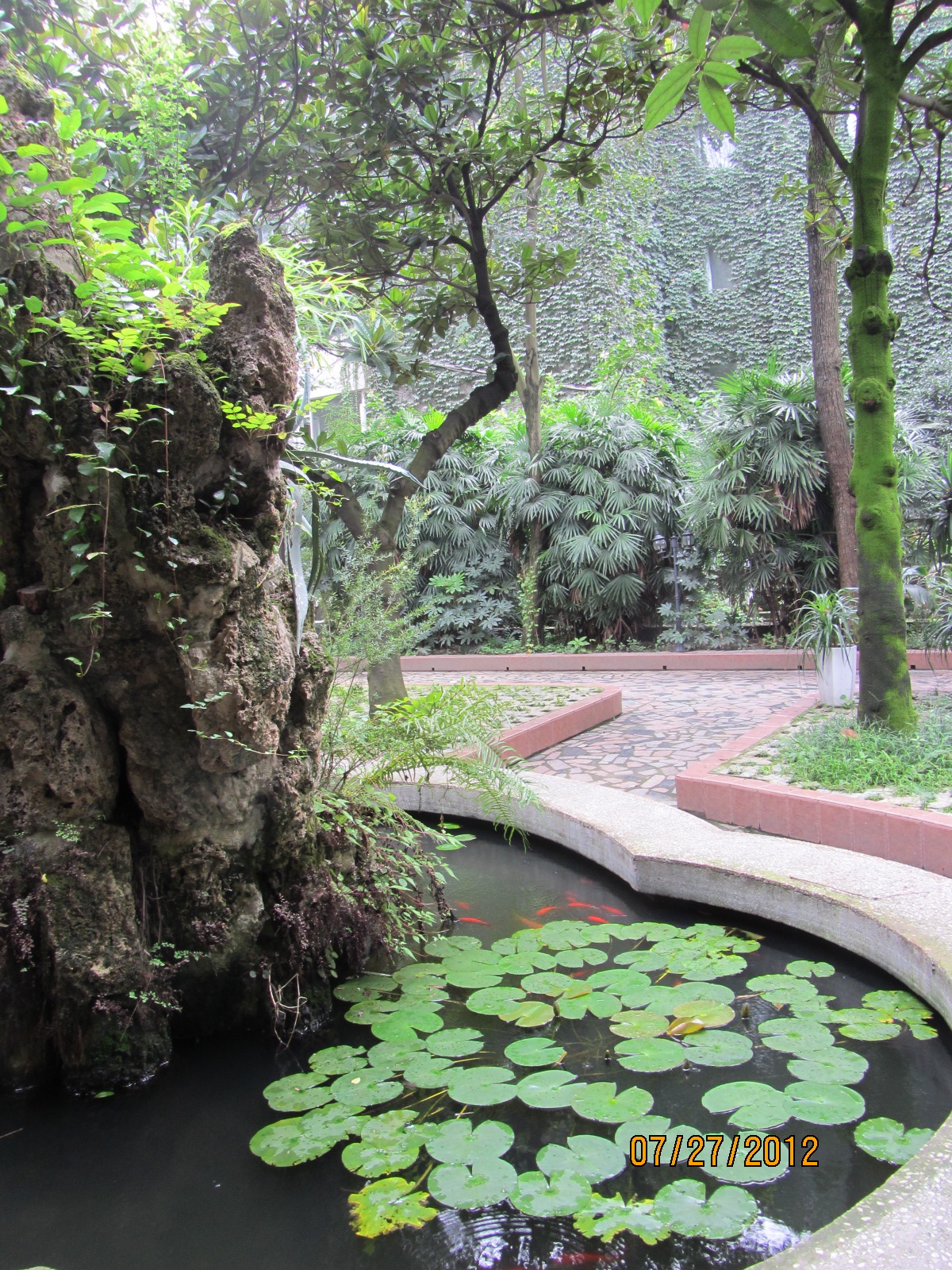
Back in Chengdu, aesthetics could shift with the snap of a finger. I spent two months in Chengdu at Sichuan Shifan Daxue, a smaller campus, where we studied Chinese and taught English in Model School. I could spin on my heel and one minute face the dirty photocopier shown on the right. If I needed photocopies for teaching, I would use this machine (with directions in Chinese, of course), one of many old photocopiers wedged under stairways or in between jiaozi shops. Many of the tiled walkways were uneven, possibly a reminder of the 2008 earthquake, and sometimes the nearby squat toilets reeked in the summer heat. And yet, if I spun around on my heel and looked forty feet behind the photocopier pictured here, I'd see the beautiful little garden, one of many throughout the campus, pictured below. Competing with the hum of cicadas in the lush, magnificently groomed gardens might be the steady rhythm of voices . . .a student under this tree, another under that, reciting lists of exam terms. 
Thursday, September 6, 2012

1962


It isn’t the year 1962, tucked away in the past, that I think about while here in Western China a half century later, but rather the dynamic double-edged-ness of everything.

To be sure, it’s not just a matter of the past—for China holds its own on this side of the digital divide. It has a techno-savvy culture and can point to astonishing feats of engineering—think of the Bird’s Nest (of 2008 Olympics fame) or the Three Gorges Dam (the largest in the world) or the sheer magnitude of infrastructure in any of its scores of cities with many millions of people. Even in the countryside of Sichuan, a train zipping through green terraced mountains and rice paddies might suddenly come upon a hamlet featuring a dozen thirty-story buildings under construction. And whether at badminton, ping pong, or piano, the Chinese push for excellence, doing their best. So the point isn’t that China is low-tech, uncultured, or stuck in the 1962 that I knew.

The 1962 I experienced was decidedly low-tech. I had never seen a computer, we opened the windows wide on hot summer nights, and my mother still darned our socks and hung our clothes out to dry. We never trooped into a restaurant unless Great Aunt Ruth was treating us to dinner in Ithaca, New York—and McDonald’s had yet to make a big dent in American culture. Not surprisingly, my mother didn’t need Michael Pollan to educate her about the slow-food movement or the virtues of eating local produce—slow food was the only food.

I can wax nostalgically about all of these things, and I see that they aren’t entirely lost here in China, where I eat one peeled grape at a time, one shelled peanut. (For clumsy me, chopsticks slow down eating, too.) Chinese women take their bags to market, haggle for the best prices on a stunning array of fruits and vegetables (none of which is wrapped in plastic or Styrofoam), and head home to prepare up to four dishes per meal, each featuring multiple veggies and herbs. The steps are slow and deliberate. The food is fabulous. Nothing is wasted.

In hot and muggy Chengdu (where I lived in July and most of August), most apartments have a tiny washing machine and room air conditioners, but these are seldom used. Instead, most people hand-wash the day’s clothes and pin them up on one of the clotheslines gracing every balcony in every complex. To minimize excessive laundry, most ladies change into simple cotton housedresses at home.

Here – there – wherever – whenever – this attention to doing things slowly and living lightly on the earth is something I cherish. But 1962 wasn’t always pretty, at least in my hometown of Trenton, Michigan. Trenton was in the armpit of the industrial Midwest, the land of “pink chemical nights” (thanks, Eugenides). Trenton’s graduating class of 1962 couldn’t have been more clean-shaven and clean cut, but the nearby Detroit River was multi-colored and toxic. Rachel Carson was with Silent Spring about to draw attention to the effects of DDT on birdsong, and the horror of Love Canal was about to mobilize a new era of regulations and protections.

Paradoxically, Trenton may have witnessed the best and the worst of a largely unregulated culture in 1962, still seemingly simple enough and do-it-yourself at home, while chemical and auto industries were transforming our airways and highways. People still had primarily sustainable, green practices, but other forces were at work, about to radically transform the environment. Likewise, I see in China quaint one-lane mountain villages about to be transformed by the appetites of automobiles. Big box stores are coming to cities. My good sense of direction is challenged by the fact I can never see the sun through the bright metallic haze. I must boil or distill all of my drinking water; I must peel my fruits and vegetables, one grape at a time.

So, if it’s not the year 1962 that I think about, it’s the paradox of progress. At the foot of the hill where we foreign teachers live in Beibei is the jiaozi woman’s tent. I watch her throw handfuls of fresh xincai into the pot gurgling over her open flame. Her elderly father sits at a nearby table, nimbly pinching together trayfuls of dumplings. From under the flap of that tent, I can see the Beibei skyline, scores of skyscrapers piercing the orange evening haze.